Showing posts with label William Gibson. Show all posts

Wednesday, June 10, 2009

Before they were famous

Number One in an occasional series.

So I thought I would take a look, when time and opportunity permit, to read and review the early stories of writers that I rate.

The Clash, Chateau Neuf, Oslo, Norway, May 21s...Image via Wikipedia


I think I'm doing to make myself feel better, in that I'll find that some of their early stuff was as bad as my stuff and therefore kid myself that my career, such as it is, resembles theirs enough to give me hope that I can make this work. I suspect I'll find it's a bit more complicated than that.

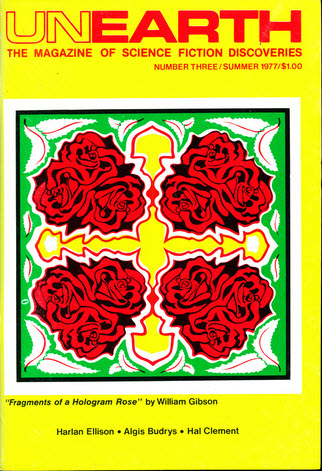
Justification over, I'll move on to the first choice which is "Fragments of a Hologram Rose" by William Gibson. Even before I read it, again, I found out two startling facts. First, it was published in 1977. When I was a mighty ten. And second that William Gibson is over 60 years old.

That 1977 publication date knocked me out. That's why, I guess, the punk label gets applied to stuff done in the same style because of the chronological suture with the proper punk. Hmm.

It was published in UnEarth 3. Which, I read, was a short-lived SF mag (1977-79) and he got paid $23 for it. Holy crap there is a copy available still to buy. How about that. It was edited by Jonathan Ostrowsky-Lantz and John M. Landsberg. JML wrote a few stories and a couple of novels and JOL didn't. This story knocked me out. Look for "What baggery is this?"

On to the story. Which is really short, about 2,000 words or so I'd guess. And its pretty damn good. Whole and polished. No stuttering lights here, just full beam all the way. Pretty much all the elements in later Gibson are there in the first instar. The neat technology, the astonishing attention to detail, and the human element too. It's all about the end of a relationship and the tech is used to underline just what is lost and how it all went wrong. Poignant too.

Some of the names that crop up in later Gibson works are there too - Sendai, in particular.

I bought a copy of Burning Chrome, the anthology, to get at Fragments and I've picked through a few of the stories. Most of which are good, some great and some, like the title work, out and out fab.

In the spirit of wanting to learn from reading I'll mention what I have spotted. And this builds on something I noticed last week. Details are important, essential even, to establishing that sense of place.

EssayImage by Martin Kingsley via Flickr


Though one passage, in New Rose Hotel, did make me snort it seemed so over the top. This is it

"He'd found a German girl with a taste for conservative loden and riding boots polished the shade of a fresh chestnut."

Fabulous. For reference loden is that houndstoothy, twilly cloth seen in traditional German costumes.

What I also picked up on though was their simplicity. The profundity of the stories comes from how straight-forward they are. They do not attempt to be clever before they are clear. I've often been accused of doing the opposite. Good lessons from Mr Gibson. He'll go far.

Saturday, March 14, 2009

Reading redux

So it wasn't just the James Herbert books that I brought back from the visit to my mum. And over the last few weeks I've been re-reading a few of them. What I find amazing is how present to my memory they all are. Just looking at the covers I can call up names, places and incidents from all of them - though I haven't cracked the covers of any of them for more than a decade. It makes me realise how influential they were on me. The downside is that I'm spotting lots of the tropes that I use popping up in these texts. Hmm. Anyhoo.

Harry Harrison - most of the Stainless Steel Rat series. Still very enjoyable - though very light. The breezy style and insouciant charm of slippery Jim DiGriz sweeps each tale along but what I notice now is what escaped me back then. Even now I can remember

The Stainless Steel Rat Saves The World - Cove...Image via Wikipedia

reading the first page of The Stainless Steel Rat in Miss Ellison's class when I was 10? 11? She gave it to me, Nick Dodd, Mark Sanderson and Des (?) as part of a lesson on different sorts of writing. We all hated Miss Ellison as she closed her eyes whenever she said a word with an "s" in it. I'm not sure why that made us hate her but it did.

What I loved back then was the radical feel of the thing and the sheer confidence that Jim oozed; but now I see how adept HH was at using that style to skip over the holes in the plot and bamboozle the reader.

What is also fascinating is its attitude to technology. For instance, in The Stainless Steel Rat Gets Drafted when Jim and his sidekick need to record some video ready for broadcast they go to a TV studio and use the equipment there. Now, of course, it'd be done with a camera on a phone or a web cam and posted online - etc etc. It shows exactly how stories of the future are mired in the present of their creators. But that's also quite liberating because it was never supposed to be THE FUTURE simply a future which means that pretty much anything goes.

William Gibson - Count Zero. Such a great read. Better, by far, than I remember. Just astonishing in places and so dense with ideas and insights. Now that the net is everywhere some of the supposed changes it documents make it looks a little dated.
- No cellphones.
- Using the net involves travelling to places.
- ICE
- Rampant AIs
- Gods in the net
I had a sense when I was reading it that I was missing something that would become clear as I got older. Well, I am and its not. I guess I'm just too thick to catch on.

Terry Pratchett
- The Colour of Magic/Light Fantastic. My good friend Carl Berks recommended the first one to me when I was 15/16. I met him via a gaming group that I joined. Reading it again I remember the "watcher-of-the-skies-new-planet" feeling I got having read it. It was also much funnier than I remember. And the Discworld portrayed in the first two books is very different to what it becomes later on in the series. Death is murderous in these books, the Gods are much more present and there are lots of standard fantasy wallpaper to bulk out the story.
Reblog this post [with Zemanta]